


Should you self-report? A board-level decision framework

The AFP’s April 2026 guideline has turned self-reporting into a live boardroom decision rather than a theoretical one. If a company finds evidence of serious misconduct, the board now has to decide whether to take it to the AFP, knowing that genuine cooperation can lead to a civil resolution with no conviction, and knowing that the price is high. This is living aside other considerations about reporting crimes that come from the various Crimes Act type legislation throughout the country. This is a structured way to make that decision, drawn from the factors the AFP itself says it will weigh.
Start with the threshold questions
Before anything else, the board needs a clear-eyed answer to three questions, developed with advice and on a privileged basis:
Is there a reasonable basis to think an offence has occurred, and how confident are we in that assessment? Also asking would a jury convict on this evidence?
What is the likely scope, in conduct, value, time period and jurisdictions?
Who appears to be involved, at what level, and were any directors or senior managers aware or complicit?
The honest answers shape everything that follows. A problem confined to a rogue individual against an otherwise sound compliance framework is a very different proposition from lots of terrible conduct by a number of individuals that had reached the board.
What the AFP will weigh
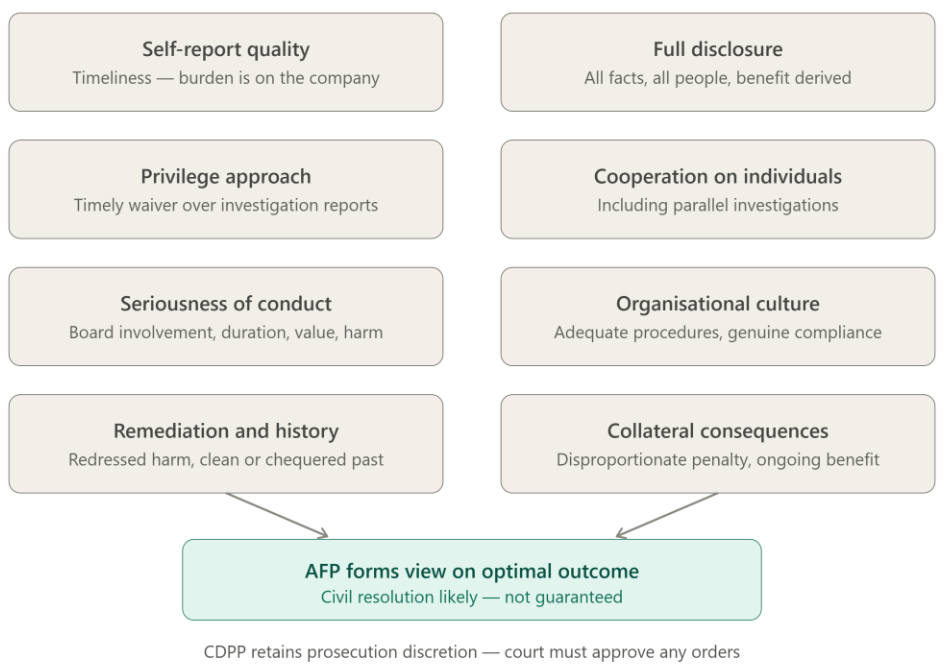
The guideline is reasonably transparent about the factors that drive its assessment. In plain terms, the AFP looks at:
Whether the company self-reported, and the quality and timeliness of that report. The burden is on the company to show it acted promptly.
Whether the company disclosed all the relevant facts and all the people involved, including the company’s own role and the benefit derived.
The company’s approach to legal professional privilege, including whether it waived privilege over internal investigation reports in a timely way.
Whether the company cooperated in relation to individuals and any parallel investigations, here or overseas.
The seriousness of the conduct, including board or senior involvement, duration, value, and harm.
The culture of the organisation, including whether it had adequate procedures and a genuine culture of compliance.
Whether the company has remediated, redressed harm, and has a clean or chequered history.
Whether a court-imposed penalty would have disproportionate collateral consequences, and whether the company still benefits from the conduct.
A decision framework for the board
Against that backdrop, a board can work through the decision in a defined order:
Preserve and assess. Secure documents and data, establish privilege over the investigation, and do not destroy or alter anything. Get a clear, advised picture of what happened before deciding anything.
Take advice before reporting. Self-reporting and privilege waiver are the irreversible steps. Nothing should be said to the AFP until the board understands the full picture and the consequences.
Weigh the cost against the benefit. On one side: full disclosure, waiver of privilege, cooperation against individuals, and relinquishment of the benefit. On the other: no conviction, finality on the proceeds side, and a much lower risk of a corporate prosecution. Decide which serves the company.
Address timing deliberately. The burden is on the company to show its self-report was timely. If the board decides to report, delay erodes the value of doing so.
Plan for the individuals. Identify the conflict between the company and any exposed directors, officers and employees, and recognise they will need separate representation. This is both fair and risk-management.
Document the decision properly. Directors must be able to show they considered the question carefully and acted in the company’s interests. The reasoning matters as much as the outcome.
Weigh the alternatives honestly

Self-reporting is not the only option, and the framework should test the others. Not reporting carries the risk that the conduct is discovered anyway, at which point the cooperation credit is gone and the position is far worse. Partial or grudging cooperation tends to get the worst of both worlds, because the AFP assesses the genuineness of cooperation and can simply walk away from negotiations it considers half-hearted. And even full cooperation does not guarantee the outcome, because the prosecution discretion remains with the CDPP and the court must approve any orders. The board should go in understanding the realistic range, not a best case dressed up as a certainty.
One of our matters for one of the largest corporations in Australia involved Queen’s Counsel and ourselves doing an investigation and providing a board with an opinion they should report (well before this new regime). The board took onboard what we had said, weighed it up, and decided not to self report. That was their call to make.
Common mistakes that weaken the position
Boards tend to go wrong in predictable ways once a problem surfaces. The framework is partly designed to avoid them:
Reacting before assessing. Rushing to the AFP, or rushing to reassure others, before the board understands what actually happened tends to lock in a version of events that later proves wrong.
Treating the internal investigation casually. A poorly run or poorly privileged investigation can compromise both the company’s position and the individuals’, and can undercut the credibility of any later self-report. Often there is a complaint that the scope of the investigation is too large or expensive.
Assuming the company’s lawyers protect everyone. They act for the company. Exposed directors and employees need their own advice, and ignoring that creates conflict and risk for the board itself.
Underestimating the privilege decision. Waiving privilege to demonstrate cooperation is a significant and largely irreversible step, with consequences that reach well beyond the AFP investigation.
Selling the board a best case scenario. Presenting a civil resolution as a certainty, rather than a likely outcome that still depends on the CDPP and the court, sets the board up to make a poor decision on a false premise.
Doogue + George advises boards and in-house counsel on whether and how to self-report, and on managing the conflicts that follow. If your board is facing this decision, we can help you work through it before the first irreversible step is taken.
Frequently asked questions
Do we have to self-report?
There is no general obligation to self-report at large, although specific reporting duties can arise depending on the conduct and sector. The decision is usually a judgment for the board, made with advice, weighing the benefits of cooperation against its costs.
What is the single most important step before reporting?
Getting advice and establishing a clear, privileged picture of what happened. Self-reporting and waiving privilege cannot be undone, so they should come after the assessment, not before.
Does timing really matter?
Yes. The burden is on the company to show its self-report was timely, and delay reduces the cooperation credit available.
If we cooperate fully, is the outcome guaranteed?
No. A civil resolution is the likely outcome where cooperation is genuine, but the CDPP retains the prosecution discretion and a court must approve any orders. Also there are often unintended consequences for individuals.
Authored by Bill Doogue, Director at Doogue + George Defence Lawyers
Click to connect

Bill Doogue is recognised by Doyle's Guide as a Preeminent Criminal Defence Lawyer in Victoria (2026), one of only five lawyers in the state at this tier. An Accredited Criminal Law Specialist since 1998 with over 30 years' experience, he acts in major tax fraud, white collar crime, bribery, corruption, extradition, and transnational criminal matters.
In 2026, Bill was further recognised in the 19th edition of The Best Lawyers in Australia™ for Criminal Defence.